.svg)
Article
Advance Decision on Life-sustaining Treatment Ordinance takes effect: what you need to know
31 July 2026 | Applicable law: Hong Kong | 5 minute read
The Advance Decision on Life-sustaining Treatment Ordinance ('the Ordinance') officially comes into operation on 31 July 20261. The Ordinance provides a statutory framework recognizing the legal status of (i) advance medical directives ('AMDs') and (ii) do-not-attempt cardiopulmonary resuscitation orders ('DNACPR Orders').
This statutory regime enables the specification of certain life-sustaining treatments which are not to be administered should an individual lose mental capacity and one of the specified preconditions be met, hence strengthening patient autonomy by upholding the right to die with dignity, and providing clarity and legal protection for individuals, treatment providers and rescuers, and institutions alike.
While our previous article explored the legislative framework introduced by the Ordinance, this update focuses on the implementation details and practical arrangements announced by the authority during the transitional period of some 20 months leading up to the Ordinance's commencement on 31 July 2026, including, most importantly, where these documents may be stored and become readily accessible to treatment providers.
Key points for AMDs
Main functions of an AMD
- An AMD enables a person to refuse life-sustaining treatment(s) in advance. Such refusal will take effect if (i) the maker subsequently loses mental capacity to decide on a life-sustaining treatment; and (ii) one of the three specified preconditions is met2.
- Under section 3 of the Ordinance, a person is mentally incapable if, due to a disturbance in the functioning of the mind, he or she is unable to understand, retain, use or weigh information relevant to decisions regarding life-sustaining treatments, or communicate such decisions.
- The three specified preconditions are when the maker is:
- terminally ill;
- in a persistent vegetative state or a state of irreversible coma; or
- in another end-stage, irreversible, life-limiting condition.
- Life-sustaining treatment which may be refused under an AMD is defined as "any medical treatment that is necessary to keep a person alive".
According to a guidance note from the Hospital Authority, it may include3:- cardiopulmonary resuscitation ("CPR");
- artificial ventilation;
- transfusion of blood products;
- cardiac pacing;
- vasopressors;
- specialised disease-specific treatment, such as chemotherapy or dialysis;
- antibiotics for life-threatening infection; and
- artificial nutrition and hydration.
- The form allows for specification of particular types of treatment to be refused for each of the three preconditions. In other words, the treatment to be refused may differ for each precondition.
Key requirements for the making of an AMD
- The main requirements for making a valid AMD are that (i) the maker must be an adult with the mental capacity to decide on a life-sustaining treatment; and (ii) the instructions in the AMD must be presented in a clear way4.
- The AMD should be signed in the presence of two witnesses who are not interested persons (i.e. persons who are not entitled to benefit under the maker's estate, insurance policy or any other legal instrument). The first witness must be a registered medical practitioner who explains the nature and consequences of the AMD to the maker, while the second witness must be at least 18 years of age. The principle of 'cautious making' should be followed.
eHealth and storage of the AMD
- An AMD may be stored physically and electronically. The Ordinance currently recognizes the original document, a certified true copy, or a paper AMD stored in the 'designated electronic system' as valid proof of an AMD (each constituting a "validating copy" under the Ordinance).
- eHealth (醫健通)5 will serve as the designated electronic system for AMDs, with implementation taking place in phases6.
- Under the first phase, which commences on 31 July 2026:
- Individuals will still need to sign paper copies of the AMDs, but the properly executed paper AMDs may be uploaded and stored electronically on the platform with the maker's consent.
- Healthcare providers in both the public and private sectors could access and identify them when required, and will be automatically alerted on eHealth that the patient has made an AMD when they access the patient's file on the system.
- To ensure compliance with the statutory requirements, the upload should be facilitated by a registered medical practitioner from either the public or private sector, who will first verify that the AMD has been duly completed and is valid before it is stored on eHealth.
* Excerpt from the AMD form7: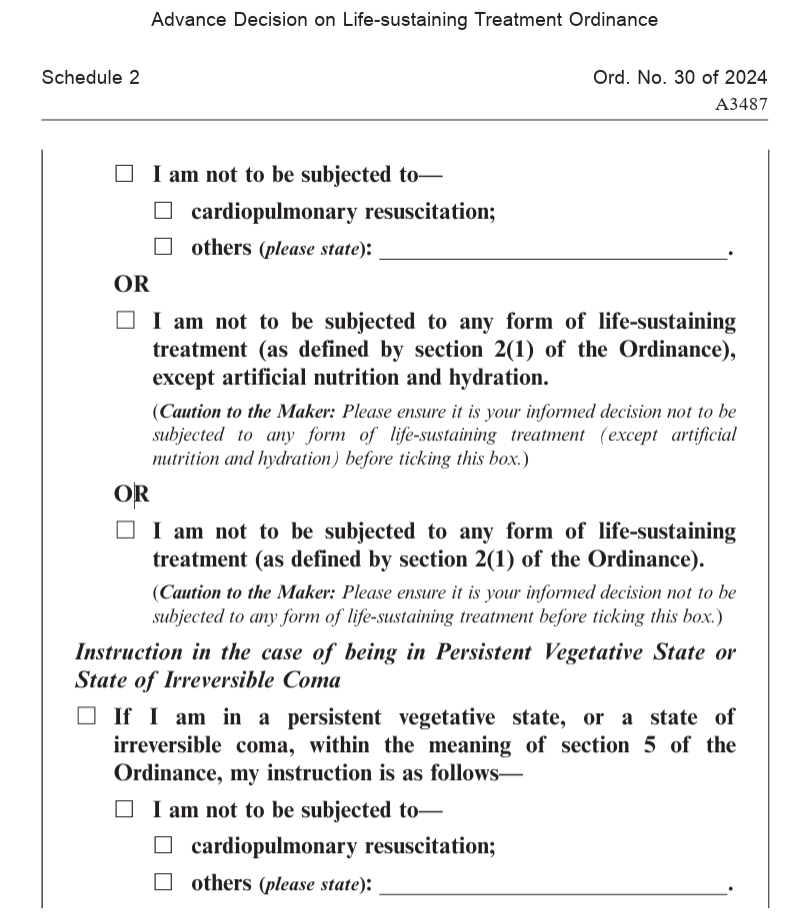
- To further harness the benefits of digitalization, the Government will introduce a second phase under which AMDs may be created, executed and stored entirely in electronic form through eHealth. No implementation timetable has yet been announced for this phase.
- Under the first phase, which commences on 31 July 2026:
- Storage in Hospital Authority ("HA") yellow pouches8:
- The HA has also introduced a standard yellow document pouch for storing an AMD and/or a DNACPR Order (further discussed below). It is clearly marked to authorise ambulance crew and other rescuers to access its contents in emergency situations.
- Patients and their carers are advised to store the pouch in a safe, readily accessible and highly visible location, such as near the entrance of the home, rather than in a locked cabinet or drawer, so that treatment providers could have first-hand notice of these documents.
* Photo of the 'yellow pouch'9: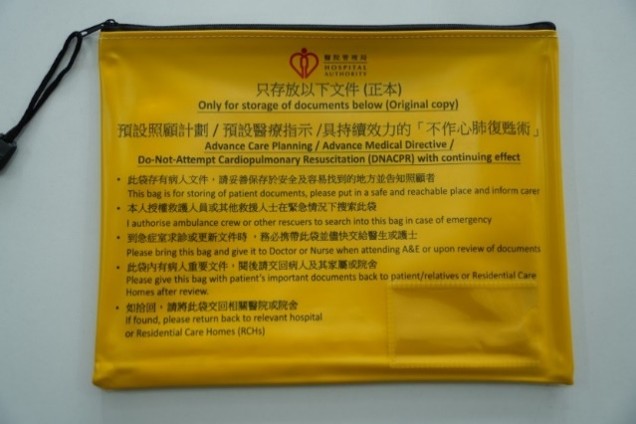
A treatment provider is regarded as having notice of the AMD when the treatment provider sees a validating copy of it10. Notice is also deemed to exist where the provider is informed that the AMD may be stored on eHealth and a validating copy is in fact stored there and accessible to the provider.
It is also noteworthy that a treatment provider is under no requirement to search for a validating copy of the AMD, whether in the patient's personal belongings or on eHealth11. If a valid AMD cannot be readily located by treatment providers or the rescuers , they will generally proceed with life-saving treatment in accordance with standard emergency protocols.
Treatment providers who honestly and reasonably believe that the instruction of an AMD is valid and applicable would be protected from liability for not subjecting the patient to the life-sustaining treatments specified in such instruction12.
- Where a treatment provider, despite having notice of an AMD and being satisfied that the relevant instruction contained therein is valid and applicable, acts contrary to that instruction by administering the specified life-sustaining treatment, the treatment provider may be exposed to criminal or civil liability, as well as professional disciplinary proceedings13.
Revocation of an AMD
- A person may revoke the AMD at any time, whether orally, in writing, or by destroying the physical document. To facilitate effective revocation, the maker should notify healthcare professionals as soon as possible so that any electronic AMD records can be updated.
- Importantly, the right to revoke an AMD is personal to the maker. Only a mentally capable adult may revoke an AMD that he or she has previously made. Healthcare professionals, family members, cohabitees, guardians and other third parties have no authority to override a valid AMD.
Notice of an AMD and protection/liability of treatment providers under the Ordinance
Which form to use?
- The Ordinance does not automatically invalidate all pre-existing AMDs. An AMD made before the commencement of the Ordinance will remain effective so long as it satisfies the equivalent requirements. A pre-existing AMD executed using the Hospital Authority’s form before the Ordinance came into force would generally continue to be valid. Following the commencement of the Ordinance, any new AMD should be executed in the prescribed statutory form.
Key points for DNACPR Orders
- A DNACPR Order is limited in scope and applies only to the withholding of CPR in the event of cardiopulmonary arrest. It does not extend to other forms of life-sustaining treatment.
- It is issued by two registered medical practitioners and is typically made for (instead of made by) adults who have already lost mental capacity, or for minors. The Ordinance enables the patient's immediate family members and persons in a cohabitation relationship who live together as a couple in an intimate relationship to request for a DNACPR Order to be issued having regard to the patient's best interests.
- Given the need for emergency responders to make immediate clinical decisions in urgent situations, the current regime does not provide for an electronic version of DNACPR Orders. They are maintained solely in physical form and are recommended to be stored in the 'yellow pouch' to enable healthcare professionals and ambulance paramedics to have immediate notice of the form and to act on the DNACPR Order in case of emergencies.
It is crucial to note that neither an AMD nor a DNACPR Order should be confused with euthanasia or medical assistance in dying ("MAID"). The Ordinance does not alter Hong Kong's longstanding legal position that euthanasia and MAID are illegal. Rather, AMDs and DNACPR Orders are intended to enable the withholding or withdrawal of life-sustaining treatments, thereby allowing the natural course of a terminal or irreversible condition to take effect.
Moreover, an AMD cannot be used to refuse basic care, such as the provision or the assistance of oral (but not artificial) food and water, nor can it be used to refuse palliative care.
We will continue to monitor developments in the next phase of implementation of the Ordinance in relation to the introduction of electronic AMDs and their further integration into the eHealth system.
While individuals can now make binding decisions in advance regarding their future medical treatment under the Ordinance, separate arrangements should be considered for the management of property and financial affairs in the event of incapacity. In this regard, an Enduring Power of Attorney ("EPA") serves as an important complementary planning tool. To learn more about EPAs and incapacity planning, please refer to our article here.
2 s.17 of the Ordinance
3 HA Guidelines on Life-Sustaining Treatment for Patients Approaching End of Life (Link here)
4 This is presumed if the statutory form is used.
5 eHealth is only available to specified identity document holders, such as Hong Kong/ Macao identity card, One-way Permit, Two-way Permit and Consular Corps Identity Card etc.
6 Legislative Council Brief on the Ordinance (Link here)
7 The AMD form (Link here)
8 Leaflet from the Hospital Authority (Link here)
9 Photo credit: Sing Tao Ltd (Link here)
10 s.19 of the Ordinance
11 s.20 of the Ordinance
12 s. 22(5) of the Ordinance
13 ss. 22(2) and 22(4) of the Ordinance
Get in touch



Related experience
As a full-service law firm, we are able to provide advice and information about a wide range of other issues. Here are some related areas.
