.svg)
Article
Biodiversity Net Gain: two years later
28 May 2026 | Applicable law: England and Wales | 3 minute read
Mandatory BNG is now over two years old and requires developers in England to deliver a measurable 10% improvement in biodiversity — either on-site or off-site. The off-site route creates commercial opportunity for landowners, who may be well placed to supply biodiversity units where developers cannot meet their obligations on their own land. BNG schemes therefore offer landowners both a potential revenue stream and the chance to contribute meaningfully to nature recovery.
Assessing the Land
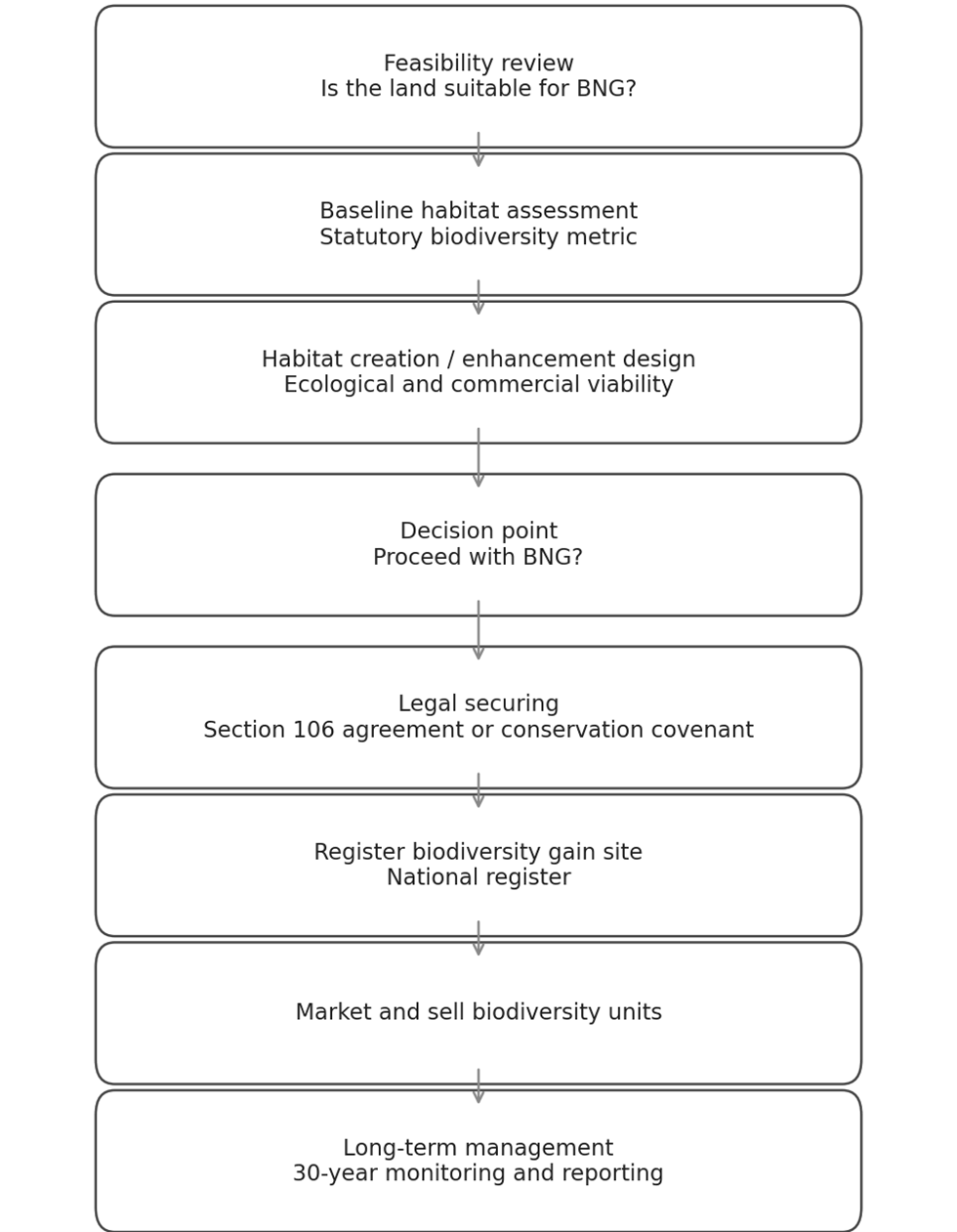
The starting point for any landowner considering the BNG market is a thorough assessment of the land's existing biodiversity value. This requires the use of the statutory biodiversity metric which calculates the number of biodiversity units a habitat contains based on factors including its size, condition and type. The metric is used both to establish a baseline and to model the uplift that could be achieved through habitat creation or enhancement.
Creating or Enhancing Habitats
Once opportunities have been identified, landowners must determine which enhancement works are most suitable. Options include planting trees, creating ponds/water features, sowing wildflower seeds, fencing, or changing existing management practices. The target habitat must be capable of reaching its required condition within a defined timescale, and the proposed habitat type should be both ecologically deliverable and commercially viable.
Securing a Legal Agreement
Before biodiversity units can be sold, a legal agreement must secure the habitat obligations. There are two options: a section 106 agreement with the local planning authority, or a conservation covenant with an approved responsible body. The agreement must last at least 30 years from completion of the habitat enhancement works and will set out the planned enhancements, the responsible parties, and the management and monitoring obligations. Legal advice should be sought before entering into any such agreement, as the obligations are binding and long-term; and we are well placed to assist with this.
Registering the Units
The land must be registered as a biodiversity gain site on the national biodiversity net gain sites register. Once registered, units can be allocated to a development, and either the landowner or the developer may apply to record that allocation.
Selling the Units
Landowners may sell independently, taking full responsibility for each step of the process. Alternatively, landowners may work with partners — such as other land managers — to create larger habitat banks and sell units collectively. A third option is to engage a habitat bank operator, who can assist with finding buyers, managing the process, and administering the legal framework.
Long-Term Management
BNG is not a one-off transaction. Habitats must be maintained for at least 30 years, and landowners remain legally responsible for ongoing management, monitoring, and reporting throughout. Unit pricing must therefore account for all costs across the full term, including ecologist fees, maintenance works, monitoring, insurance, remedial works, and inflation. Defra and Natural England do not set prices for privately sold units, so landowners must ensure their pricing model is robust and financially sustainable.
Next Steps
BNG presents a genuine proposition for landowners, but the legal, ecological, and financial implications — including tax and inheritance tax planning and the implications on residual land value — merit careful thought before committing.
Get in touch


Related experience
As a full-service law firm, we are able to provide advice and information about a wide range of other issues. Here are some related areas.
