.svg)
Insight > The Fiduciary Eye | New York art market report – June 2026
The Fiduciary Eye | New York art market report – June 2026
Welcome to the Spring edition of The Fiduciary Eye, a seasonal newsletter from 'Withers Art and Advisory' giving you a unique perspective on the global fine-art market.
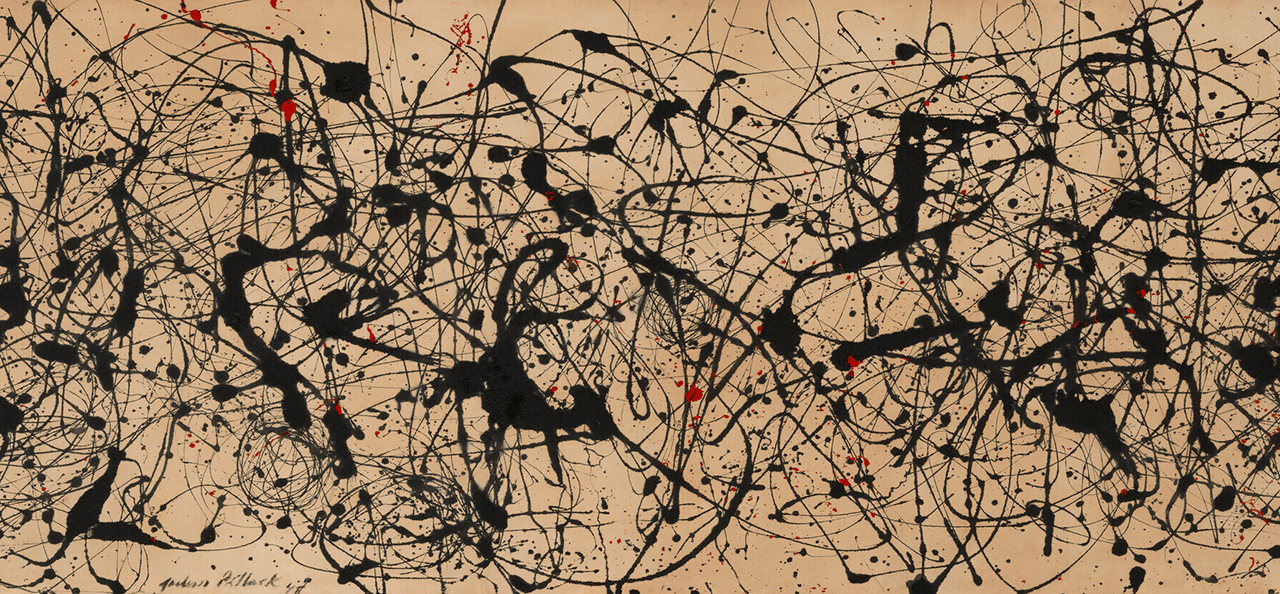
Banner image: Jackson Pollock | Number 7A, 1948 (1969) | Christie's | Masterpieces: The Private Collection of S.I. Newhouse
Welcome to the Spring edition of The Fiduciary Eye, a seasonal newsletter from Withers Art and Advisory giving you a unique perspective on the global fine-art market.
In writing The Fiduciary Eye, Mari-Claudia Jiménez and Frank Lord call upon their insider perspectives within the art world and decades-long experience in law and business to surface critical commercial and legal issues of interest to collectors and their fiduciaries.
In this issue, we review auction highlights from last month’s marquee sales in New York, where $2.5 billion in art changed hands – double the volume from just one year ago – looking beyond the headline numbers to reveal how buyers are proceeding with discernment in a market that has dramatically changed direction in just one year. But before giving you the full rundown on the week, we consider the growing importance of marketing at the highest end of the market and the continuing power of provenance in a season that boasted masterpieces from major estates.
Key fiduciary issues (or, what keeps us up at night): The power of marketing

Nicole Kidman visits Brancusi's Danaïde | Christie's
Sold for $107,585,000
Christie’s New York
MASTERPIECES: The Private Collection of S.I. Newhouse
One of the most talked-about lots this season was Constantin Brancusi’s Danaïde from the S.I. Newhouse collection – not just because of its beauty, price, or art historical importance, but because it was the subject of a lavishly produced video starring Nicole Kidman. Released just a few days before the auction, the video revolved around a private viewing of the sculpture in which the actress seems to experience an epiphany; entranced, she circles the bronze sculpture, dancing to David Bowie’s Golden Years then cancels her appointments to spend more time in the gallery. Setting aside the question of whether this Hollywood endorsement added value in the minds of potential buyers, the video definitely captured attention for the sculpture (whether it was in a positive or negative way we leave up to you). And, in a very crowded season, it ensured that the spotlight returned to the Newhouse collection in the final run up to the auction.
The question everyone was asking was: why would Christie's do this? And how does a video or this type of marketing 'stunt' help sell a collection or a particular artwork? The answer: How a collection is marketed can substantially improve how it performs by signaling its relative importance – both to the auction house and within that auction season – and substantially increases the attention it receives in the market. Over the course of our careers, we have witnessed a sea change in the way auction houses use marketing to sell art. As recently as 15 years ago, marketing was minimal and simple. The vast majority of auction house marketing budgets went to lavishly produced print catalogues and ads in the New York Times and the major art magazines. At the time, the main negotiating points for sellers with the most valuable lots revolved around getting the cover or a premium position in the catalogue and being featured in a print ad. Fast forward to today: auction houses rarely produce print catalogues for various owner sales, and print advertising has been replaced by a menu of digital options, including video, social media posts, e-newsletters, digital ads served up based on browsing behavior, and premium positioning on web sites. Auction houses invest tens of millions of dollars annually in digital marketing and data gathering, which has positioned them to attract new audiences and sell to the next generation of collectors. And before you think that no one would ever buy a multi-million-dollar artwork because they saw it on social media, we can tell you that we have had numerous experiences where a collector sees a video about a collection or first learns about an artwork through a social media post and ends up buying it!
There are many issues fiduciaries must consider at all stages of the selling process, including negotiating a detailed and distinctive marketing program as part of the consignment contract, and following through on execution. We have worked on deals in which the marketing rider for a collection includes pages of minutiae, from the precise content of videos to the timing of Instagram posts and the number of days the collection will be featured on the home page of the auction house’s website. But our work does not stop there. Auction houses are well known to promise the moon in order to land a major collection; sometimes they over commit themselves, making it critically important for advisors and fiduciaries to ensure that every aspect of the marketing plan is executed properly. This goes beyond keeping a to-do checklist, but also pushing the creative teams to deliver thoughtful, distinctive, and powerful campaigns that find the right balance between educating potential buyers and igniting their passions. This attention goes beyond the digital realm to include traveling exhibitions, positioning in events, and even how a painting is lit in the galleries. The moral of the story is that marketing does matter – a lot.
The power of provenance
There is universal agreement that provenance is one of the most important factors that buyers weigh when bidding at auction, which is why auction houses compete intensely for the estates of the most illustrious collectors. There has been a lot of data analysis to pinpoint the value of this “single-owner effect” but there are so many factors that go into estimations and bidding behavior that it is hard to predict precisely the value of a good provenance. Generally, premier estates will outperform various owner sales by several percentage points: last season, for example, the Leonard Lauder collection at Sotheby’s realized a hammer price that was 20% higher than its low estimate, while the various owner Modern Evening Auction came in just 11% higher. This season, a pair of Joseph Cornell box sculptures at Christie’s provided another illustration of the power of provenance. The two sculptures were from the American artist's 'Medici' series, which are among his best-known works. Both were estimated at $3-5 million and were exhibited side by side in the same gallery as the record-breaking Rothko (perhaps the auction house hoped that a collector would buy the Cornells as a set). The box featuring the “Medici Princess,” from the Agnes Gund estate, soared to $6.9 million, while the “Pinturicchio Boy,” belonging to a collector only referred to by the marketing designation "Radical Genius: Works from a Distinguished Private Collection," went unsold, a rare casualty in a carefully orchestrated auction with a 96% sell-through rate. Perhaps the fact that the Boy had been on the market nine years ago, selling at Sotheby’s (for $4.2 million), made it less appealing to buyers, while the Princess had been in Gund’s collection for 46 years, giving it a freshness the other lacked. But surely provenance gave the Princess more than a little edge.
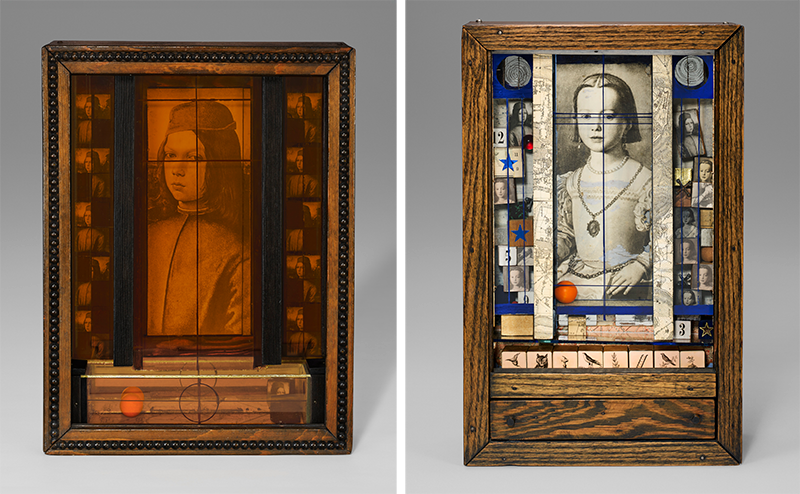
Two box sculptures from the same series by Joseph Cornell hung next to each other at Christie’s and carried the same estimate: $3-5 million. Pinturicchio Boy, on the left, from an anonymous collector, went unsold while Medici Princess, from the Agnes Gund collection, soared to $6.9 million.
May 2026 season: Cautious buyers with deep pockets drive the market
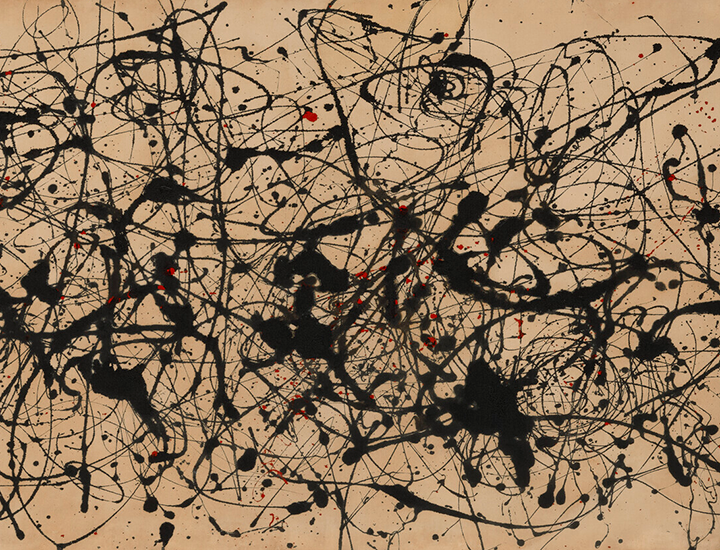
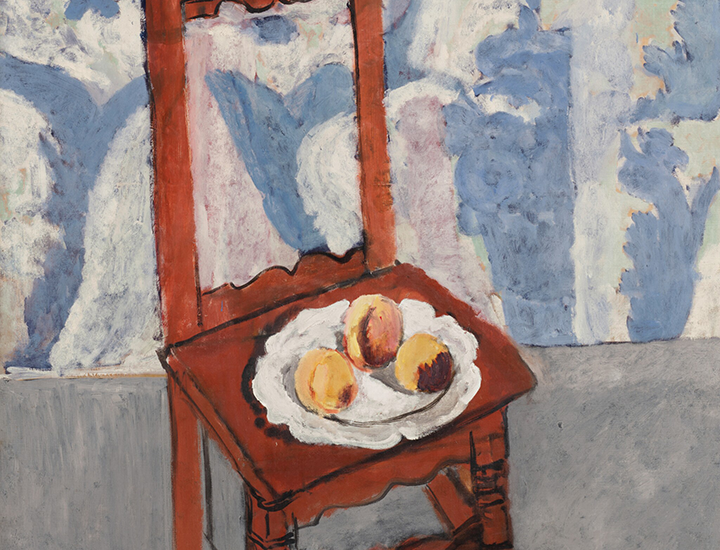
By many measures, this was the strongest auction season since November 2022, solidifying the broad market recovery that began last fall after three lackluster years. New records were set for several masters of 20th century art, led by Jackson Pollock ($181.2 million for the largest of the artist’s drip paintings to remain in private hands, from the collection of S.I. Newhouse), Mark Rothko ($98.4 million for a brooding late work, this one from the collection of legendary collector and philanthropist Agnes Gund), and Constantin Brancusi ($107.6 million for a gilded bronze sculpture of a head, also from the Newhouse collection). Along the way, another exceptional Rothko owned by collector turned dealer Robert Mnuchin sold for $85.8 million, an unusual Henri Matisse painting of a chair soared to $48.4 million, and a suite of paintings by Gerhard Richter owned by his late dealer, Marian Goodman, proved the continuing allure of the contemporary painter whom many consider to be the world’s greatest living artist.
For the most part, trophy works with impeccable provenance continue to command fierce competition, as they did in the November round of sales, but buyers remain deeply selective and increasingly attentive to third party guaranties and value. Unlike the March round of sales in London, where you could feel an almost frenetic energy in the auction room, the New York sales were far lower key, especially at Sotheby’s – in its new home at the Breuer building, the auction house can only accommodate a fraction of the audience it used to hold in its York Avenue saleroom, significantly diminishing the buzz factor. Almost all the top lots offered at the three houses (Christie’s, Sotheby’s and Phillips) carried “irrevocable bids” from third parties, meaning they were guaranteed to sell, eliminating suspense and ensuring there would be no embarrassing flops.
Highlights from the New York sales
Jackson Pollock | Number 7A (detail), 1948
Sold for $181.2 million
Christie's
Masterpieces: The Private Collection of S.I. Newhouse
Courtesy Christie's

Highlights from the New York sales
Constantin Brancusi | Danaïde, ca. 1913
Sold for $107.6 million
Christie's
Masterpieces: The Private Collection of S.I. Newhouse
Courtesy Christie's

Highlights from the New York sales
Mark Rothko | No. 15 (Two Greens and Red Stripe) (detail), 1964
Sold for $98.4 million
Christie's
20th Century Evening Sale
Courtesy Christie's

Highlights from the New York sales
Mark Rothko | Brown and Blacks in Reds (detail), 1957
Sold for $85.8 million
Sotheby's
Robert Mnuchin: Collector at Heart
Courtesy Sotheby's
Highlights from the New York sales
Henri Matisse | La Chaise lorraine (detail), 1919
Sold for $48.4 million
Sotheby's
Modern Evening Auction
Courtesy Sotheby's

Highlights from the New York sales
Gerhard Richter | Kerze (Candle) (detail), 1982
Sold for $35.1 million
Christie's
Breaking Ground: The Private Collection of Marian Goodman
Courtesy Christie's
Auction house totals
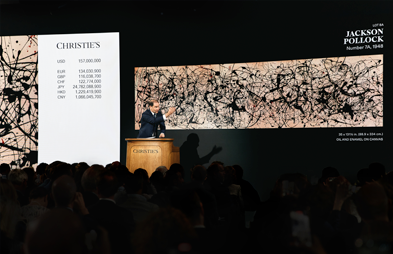
Christie's | US$1.453 billion
Image: Courtesy Christie's
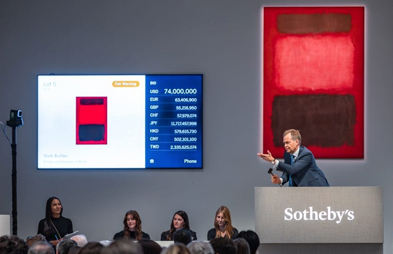
Sotheby's | US$909 million
Image: Courtesy Sotheby's
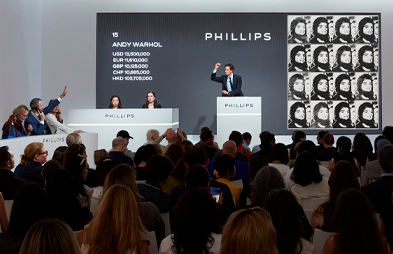
Phillips | US$146 million
Image: Courtesy Phillips
Great estates dominated the season, led by a selection of 16 works collected by Newhouse; even though the media mogul died in 2017 and many of his greatest trophies have been sold judiciously over time, a significant portion of his vast holdings were held back, waiting for just the right moment to come to auction. Powered by the Pollock and Brancusi, the Newhouse sale brought $630.9 million against a $462-$595 million estimate. But even though works sold solidly, quite a few hammered at or below the low estimate. The Brancusi, which had been heavily hyped by Christie’s through that Nicole Kidman video and other attention-getting devices, went to the guarantor after just one bid. The work became the second most valuable sculpture at auction, but the $107.6 price it reportedly commanded (including hammer plus buyer’s premium) may be misleading; as Mari-Claudia noted in a recent New York Times article, the buyer “could have paid a number very far below $107 million.” We have negotiated many agreements with third-party guarantors, and these often include a “financing fee,” which would be subtracted from the total in the event that the guarantor is the eventual buyer. While Sotheby's reports a work's price net of its financing fee, Christie's does not, which means we will never know what the Brancusi actually sold for. This is one of many examples of how the art market often lacks transparency, leading clients transacting at the highest levels to seek expert guidance in order to navigate it successfully.
Two of the estates offered this season came from dealers – Robert Mnuchin at Sotheby’s, and Marian Goodman at Christie’s – which posed an interesting challenge for the auction houses. Unlike Newhouse and Gund, who spent their lifetimes carefully assembling a coherent group of works that became deeply connected to their identifies, dealers are generally much more transactional: everything they own has a price. By titling the Mnuchin sale “Collector at Heart” Sotheby’s sought to position the works left in his estate as ones that were personally important to him rather than merely unsold inventory; similarly, Christie’s dubbed their sale “The Private Collection of Marian Goodman,” with their narrative focusing on the critical role that Goodman played in the development of Richter’s career. Ultimately, a dealer’s provenance tends to be less alluring than a private collector’s. The top Mnuchin lot, a sensational Rothko from a coveted period, hammered just above its low estimate, while the most expensive Richter from the Goodman collection, a heavily promoted painting of a candle, sold below its low.
Americans were by far the dominant nationality among buyers, so it’s not surprising that Abstract Expressionists shone this season, not just Pollock and Rothko, but top-tier works by Franz Kline and Willem de Kooning from the Mnuchin collection also saw strong results. American Minimalism from the Henry S. McNeil, Jr. collection at Christie’s also generally did well, led by a $12.8 million Donald Judd sculpture.
The overall takeaway is that the market is continuing to build confidence on both the selling and buying side. What we are seeing is a cautious market favoring trophy works by canonical artists from leading collections. But buyers have shown that they are still quite discerning about estimates and avoid getting caught up in a bidding battle unless the price is right. This season again showed that the auction houses are highly dependent on estate property, and competition for that property is fierce; this usually leads to aggressive estimates, which can stifle bidding. As with the past few seasons, we still aren’t seeing a lot of fresh Contemporary work coming to market. Perhaps the strong results of this season will tempt more discretionary sellers to come back in November.
Summary of evening sales results
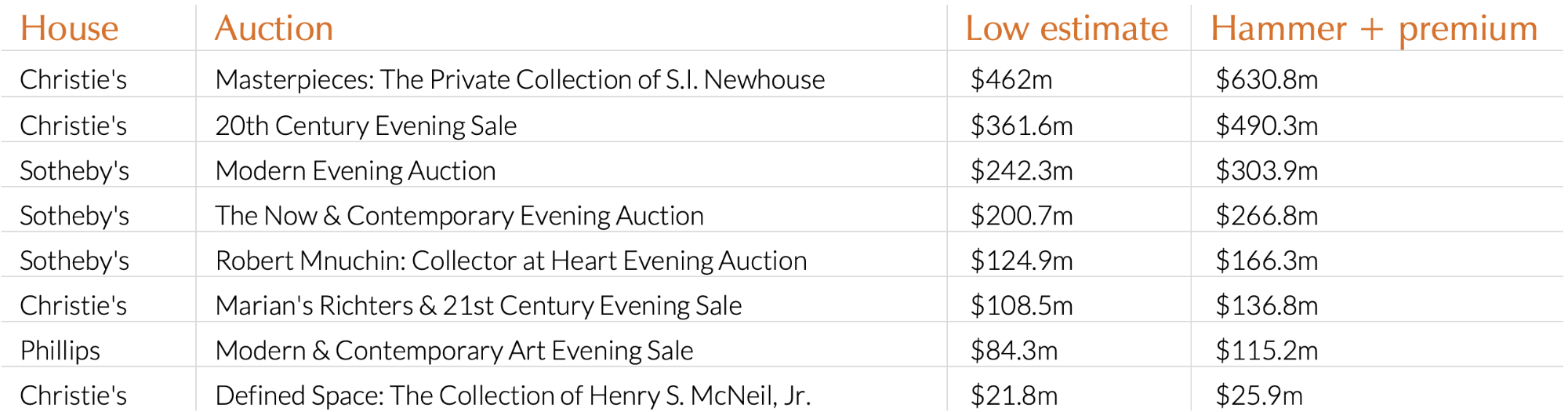
Consolidated sales, New York Marquee Auctions (Christie's, Phillips, Sotheby's)
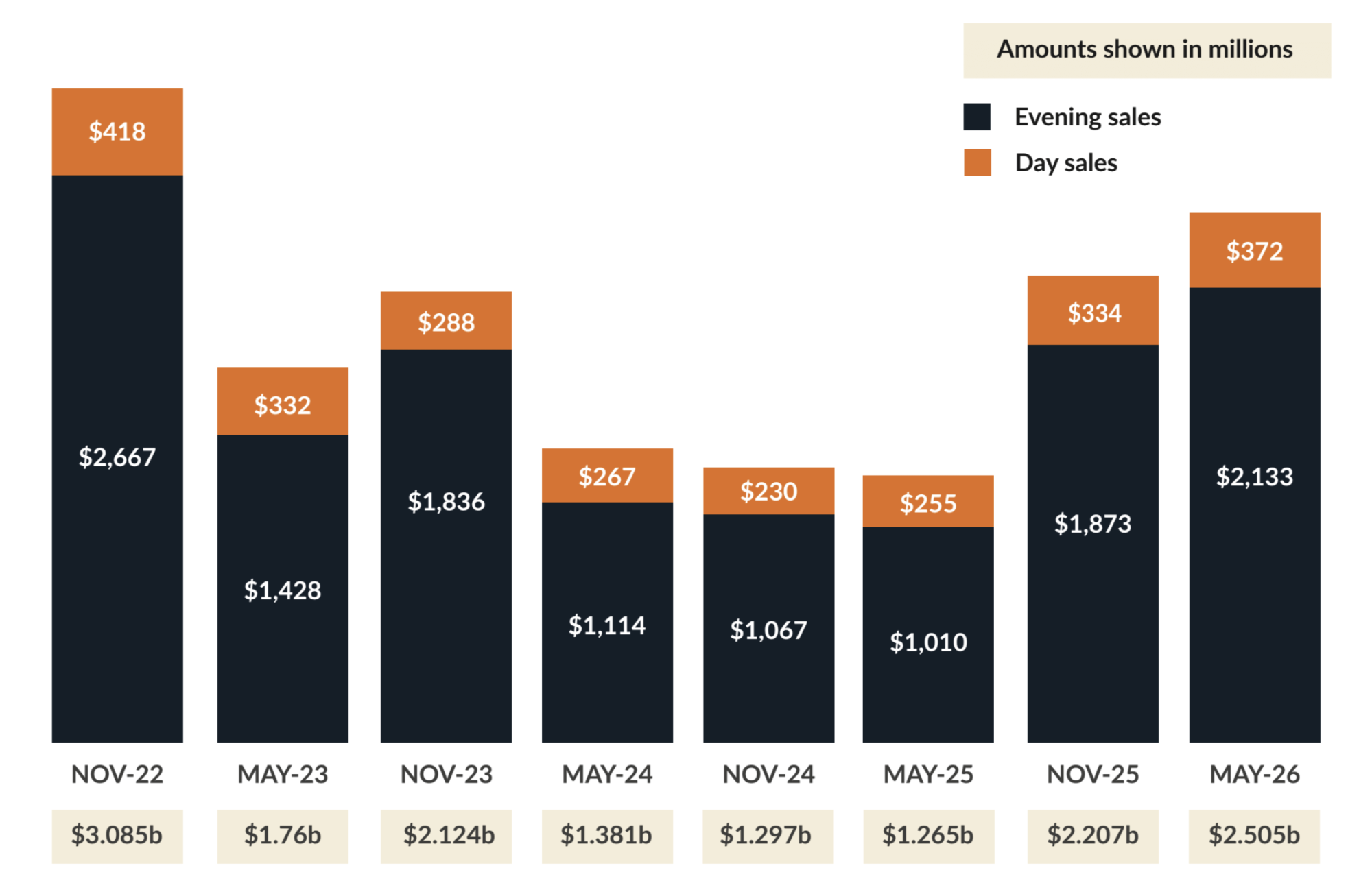
Trophy Lots Sold, November 2022-May 2026
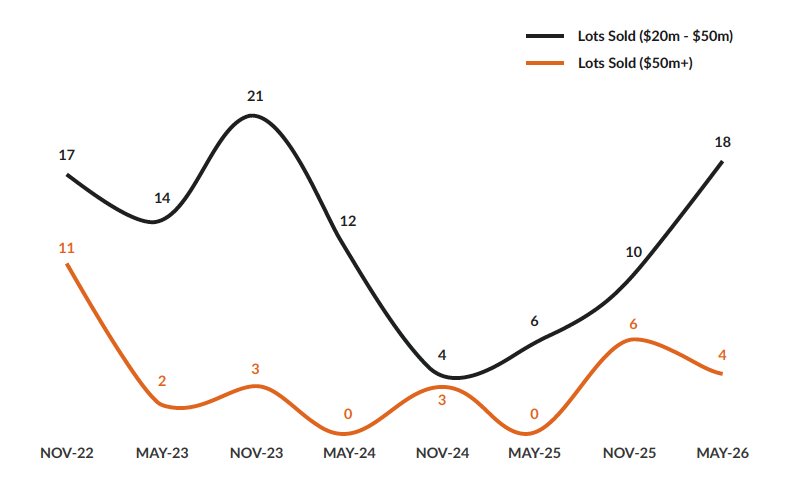
The Rothko market: Beyond the hype
One of the points we’ve focused on is blockage: the issue of how many similar works can be offered simultaneously without damaging market values. This season provided an excellent example of the problem. Prospective buyers were offered six paintings by Mark Rothko with an aggregate low estimate of $180.3 million. Two of these were estimated above $70 million, two between $10 million and $20 million, and two below $10 million. The obvious question: Could the market absorb so many pieces while maximizing prices for all of them?
Of course, we now know that the pieces sold well – each cleared its low estimate – which is a great result for the Rothko market. But on closer inspection, it probably shouldn't have been a surprise.
The previous auction record for a Rothko was set in May 2012, when a 1961 example sold for $86.9 million at Christie’s. Since then, the auction market has repeatedly demonstrated that it had an appetite sufficient for both a large number and a large dollar volume of Rothko works:

Those are big numbers, but they are still smaller than the aggregate low estimate of the works offered this season, until you adjust for inflation:

So, in real terms, the aggregate low estimate of the works for this season was not even a stretch. Indeed, the aggregate total sale price of $231.7 million was lower than the inflation-adjusted sale total for May 2015.
Where this season was different was in the concentration of value. Going into the sales, Christie's and Sotheby's both signaled that they expected to sell a work in range of the previous auction record for a Rothko — as ultimately they both did. But, here again, history suggested that the market would be up to the challenge. In May 2015, one work sold for over $80 million and two others sold for in excess of $40 million. From that perspective, a total of $160 million or more for two works seems like a reasonable bet. Reportedly, an important Rothko sold privately in 2014 and 2024 for more than $100 million, also supporting the estimates this season.
On the surface, having a nearly 15-year-old auction record broken by one work and narrowly missed by another would seem a spectacular season for an artist of the caliber of Rothko. But a deeper dive into the numbers suggests that, based on historical performance, it was a solid market without fireworks.
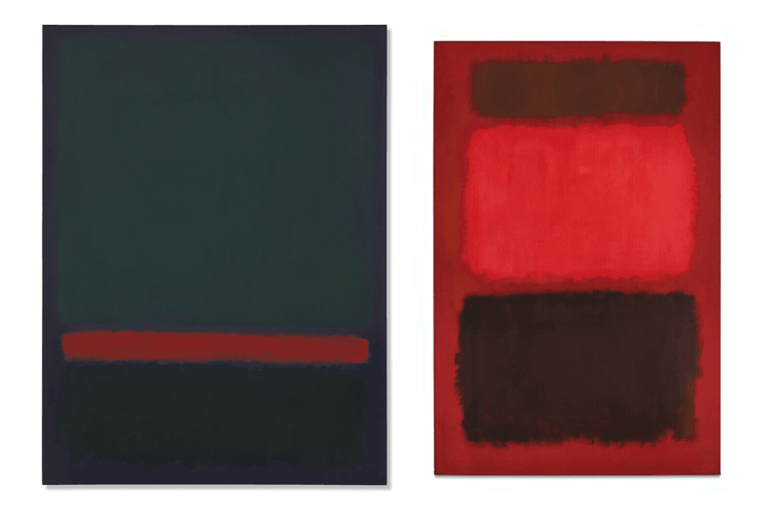
Mark Rothko’s No. 15 (Two Greens and Red Stripe) (left) sold for $98.4 million this season at Christie’s, breaking the artist’s record set in 2012. Rothko’s Brown and Blacks in Reds brought $85.8 million at Sotheby’s, just below the 2012 record price of $86.9 million.
The season ahead
The summer sales in London are often modest in scale, but this June Sotheby’s will be offering works from the collection of billionaire financier Joe Lewis and his daughter Vivienne worth more than $200 million. It’s the biggest single-owner collection ever offered in London and follows the successful March sale of four paintings owned by Lewis that collectively brought $47.7 million. That auction of works by School of London painters Lucian Freud, Francis Bacon, and Leon Kossoff did unexpectedly well, laying the groundwork for the summer offering, which features major paintings by Viennese masters Gustav Klimt and Egon Schiele, Amedeo Modigliani, and Gustave Caillebotte – and headlined by a monumental Freud canvas from his celebrated series of nude portraits of benefits supervisor Sue Tilley. It is certain to be a major test of whether London can recapture its preeminence as a European selling location post-Brexit.
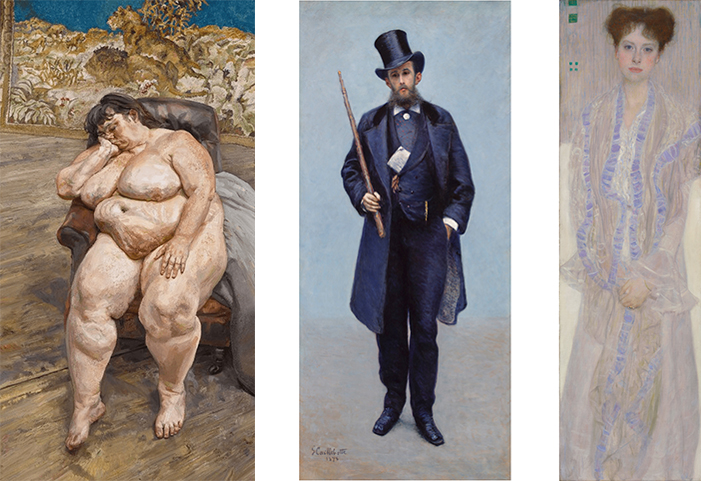
On June 24, Sotheby’s London will offer Masterpieces from the Lewis Collection, the highest valued single-owner collection ever to come to auction in London. Highlights include (left to right) Lucian Freud’s 1995-96 Sleeping by the Lion Carpet, Gustave Caillebotte's Portrait de Paul Hugot, and Gustav Klimt’s Portrait of Gertrud Loew.
How we can help
Authors

Mari-Claudia Jiménez
Partner | Co-head of art law | Withers Art and Advisory | New York
Mari-Claudia Jiménez
Partner | Co-head of art law | Withers Art and Advisory | New York
Withers Art and Advisory
View Profile
Frank K. Lord IV
Senior Counsel | Withers Art and Advisory | New York
Subscribe to The Fiduciary Eye
Our seasonal newsletter will be published on our website twice per year. Subscribe to ensure you receive a copy direct to your inbox.